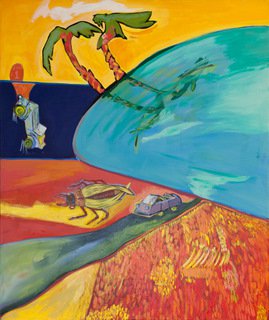
Guasmo is a slum in the wealthy port city of Guayaquil, Ecuador, where approximately one million people live. Although they live directly beside the water, they have no access to clean water—a paradox they share with millions of people around the world. Access to clean water, like living in a democracy, has become a distant hope for many. What is an ordinary part of everyday life for some remains a dream for others; what some have in abundance, others lack.
The installation Guasmo explores this contrast between abundance and scarcity by recreating the environment of a slum situated just above the waterline. Visitors become part of the installation as soon as they enter the space. Before entering the stylized shacks, they exchange their shoes for plastic bathing shoes or rubber boots, physically placing themselves within the conditions represented by the work.
The installation consists of seven walk-in shacks, each approximately 6 × 6 metres in area and 2.7 metres high. Their construction reflects the simple structures found in slums, using wooden boards, cardboard and sheet-metal roofing, without a sewage system. The shacks are connected by simple walkways and stand just above the waterline of an artificial body of water. At the entrance, a dripping-water system moistens the area and creates the characteristic damp, musty smell associated with such environments.
Inside, an altar is installed behind Plexiglas or glass and filled with objects associated with water consumption, including a bathtub, shower, toilet and urinal. Presented as luxury goods, these everyday objects emphasize the contrast between those for whom water is readily available and those for whom access to clean water remains uncertain. In this way, the installation confronts the relationship between human needs, environmental conditions, abundance and scarcity.
The social reality behind the installation is an essential part of the project. Guasmo is affected by severe economic hardship, violence, poor sanitary conditions and very limited access to medical care. The original project documentation also states that approximately 70% of the population is illiterate and describes how its large voting population has been repeatedly exploited by politicians. At the same time, local initiatives exist, including the women’s group “Ni esclava ni Puta”, which works for women’s rights.
The project was developed through sketches, architectural planning and consultation with structural engineers, while its realization was intended to be documented through film and photography. Guasmo ultimately uses the language of installation art to make the contrast between privilege and deprivation physically perceptible, transforming the unequal access to something as fundamental as clean water into an experience of space, environment and human existence.